Showing posts with label cement test. Show all posts

Cement Test

The following tests are conduct in lab for Cement:-

1) Fineness test: The property of cement that indicates particle size of cement and specific surface area is called fineness of cement. Rate of hydration greatly depend on fineness of cement and a for a rapid development of strength, high fineness is required.
Cement test 

Cement test

2) Soundness Test: It is essential for cement paste that once it has sets, does not undergo a large change in volume. The ability of cement to retains its volume after it get harder is known as soundness of cement. This test conduct to identify the excess amount of lime in cement.


Cement test
Cement test 


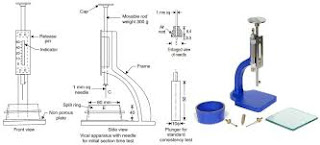
3) Consistency Test: The consistency at which cement paste will permit penetration on vicat plunger of 10 mm diameter and 50 mm length to a depth of 33-35 mm from top of the mould is defined as the standard consistency of cement. Generally, standard consistency for OPC is 26-33%.
Cement test 

Cement test


4) Setting Time Test: In broad sense setting refers to change of cement paste from a fluid state to a rigid state. Generally, Initial setting time and final setting time is required to test at lab.

Initial setting time is the state of cement mortar or concrete when it starts to become stiffen.
Final setting time is the state when cement mortar or concrete becomes fully unworkable.  
 For OPC initial setting time is 30 minutes and final setting time is 600 minutes.

5) Chemical composition Test:

6) Strength Test ( Compressive and..   Tensile): Cement has two types of strength: compressive strength and tensile strength . 
Two know the compressive strength  cement mortar cube test performed at lab.
And for tensile strength Briqutte test and split tensile test performed.
Field Test of Cement

Field Test of Cement 

Field Test of Cement: Cement is the most important ingradient for construction work. It plays vital role because it is the binding material. So ensuring good cement in construction work is important to know the field test of cement .
Cement test 
Here we will discuss about the the field test of cement:

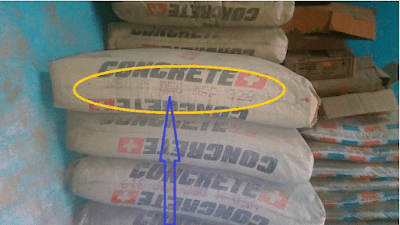
1) Manufacturing Date: As strength of cement reduced with time, so checking of manufacturing date is very important. 

   
Field test of cement
Cement Test 


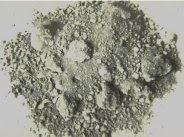
2) Colour of Cement: Colour of cement should be uniform and it would be light greenish gray.

You may Like: Field test of brick 

3) Presence of Hard Lump: Presence of lump in cement bag indicates the moisture absorption. So it should be free from lump.


Field test of cement
Cement Test 


4) Temperature: Temperature of cement in bag is very important. Normally if someone enter his hand in a cement bag it will feel cool. But if it feel worm, ( but new cement from the manufacturing will be warm) then it indicate that hydration reaction start there, which is not desired.  
Cement test 

You may Like: Field test of Sand 

5) Smoothness: When cement rubbed with two fingers it will feel smooth. Rough in feelings indicate adulteration.


Field test of cement
Cement Test 


6) Water Sinking:  If a small quantity of cement thrown on water in-case of good quality cement it will sink.

7) Flexure Test: Make a 25 mm * 25 mm * 200 mm block if cement with water. Then immersed in water for 03 days. After removing, it is supported 150 mm apart and a weight of 15 kg uniformly placed over it. If it shows no sign of failure, the cement is good.       
Cement Test 

Performing these field test you can confirm good quality cement at your construction field.


Lapping in Reinforcement

Lapping in Reinforcement L apping in Reinforcement:  Lapping length of reinforcement is one of the important term in RCC. It is a very confu...